Monday, December 19, 2016

Bold Cycles Linkin Trail and Internal Suspension

   I have been casually looking around for a medium to long travel 29er as a replacement for the Scalpel, and have come across some interesting bikes along the way. One of them is from Bold Cycles, and is immediately noticeable as different.

Bolt Cycles Linkin

   The Swiss designers over Bold Cycles Linkin are definitely going for the sleek look! What they have done is hidden the shock in the bottom of the downtube. It hosts a DT Swiss shock, which have been coming onto the scene and trying to make a name for themselves in a market flooded with Rock Shox and Fox shocks. Let's get the obvious out of the way - the hidden shock:

Cutaway shot

   The shock is actuated by an arm that works off the seat stay, and can be adjusted through a port under the bottom bracket. What else can be adjusted is the amount of travel, through switching out the linkage bars at the seat stays (where 'LT' is written below).

Linkage details

   With a bike this clean looking, anything other than exceptional cable management would have been a shame. They have a bog port near the head tube for gobbling up cables, and according to the site, air to cool the shock.

Cable entry

   The price tag for the base model is not for the faint of heart at $5400 US. Like many things Swiss, the form is great, and the function is probably also excellent.

   Translating the site to english results in some less than awesome sounding features, but we can chalk that up to the language barrier:

"A brand-new R414 damper, which was developed in close collaboration with DT Swiss and optimized and adapted for the «LT», operates within the frame. This means that the bike is equipped with extra-performance to keep even the most demanding trails downhill - thanks to the drive-neutral kinematics and the driving modes, which can be switched by the driver in three steps, for every Uphill. Coupled with a 150mm or 160mm fork, a flatter steering angle and chassis tuning, the «Linkin Trail LT» frightens nothing."

   We will have to assume "three steps" means you have three climbing settings.

Friday, December 16, 2016

Friday WTF: Awesome Cornering Edition

   CX may be over but there's plenty of cool footage still going around...


Thanks to gfycay user InformalBrightHuemul for the clip, I guess, although it had to be converted from WebM to a gif to be shared, so thanks for nothing.


Wednesday, December 14, 2016

Upside Rack

   The "Fast - Cheap - Good" triangle has eluded designers forever.


  When it comes to roof racks, you can usually get two of them easily. Bike racks are either expensive, shitty, or take forever to use. The guys over at Upside Rack are trying to build a rack that will close this gap. The Upside Rack is eye catching from the start: Your bike is mounted by the seat and handlebars, not the wheels or frame.

Upside Rack in use

   The rack is designed to work with any car with roof bars - something many cars come with from the factory. It is easily removable, and packs down so it can be carried around.

Diagram from Kickstarter site

   Surprisingly, the rack goes on the bike first, then you put both on the car. The first 30 seconds of this video answer a lot of questions about how it works. I like that the clamp for the handlebars and the hook for the roof bars are one part, that is a clever design.

   The rack looks to be very straightforward to use, and the Kickstarter costs are around $100 for one rack, so that just leaves it's quality in question. With so few moving parts, it seems like it would be pretty easy to keep costs down. Maybe this is the unicorn of bike racks?

Unmounted shot


   One last video from their FaceBook page that shows mounting in more detail. I am impressed with the whole system works - the clamp, the torque limiter, the whole thing is well designed. I kind of want one. 

Monday, December 12, 2016

What Makes a Flatland bicycle?

   There's lots of kinds of biking these days... road, criterium, track, touring, time trial, triathlon, cross country mountain bike, endurance mountain bike, short track, downhill, dual slalom, cyclocross, dirt jumping, slope style, street, park, trails, trials, BMX etc. You get the idea.
   Each of these disciplines brings a different skill set, and usually, a different bicycle. I wanted to look at one of the most interesting, and specialized cycling applications: Flatland.
 
Flatland rider

   First off -  what the heck is flatland? Is it like trials? BMX? ballet? Well, it's a little of all of these. Flatland is one of those offshoot sports that is popular with a narrow group of people: the very patient and dedicated. The tricks involved aren't something you can learn by just trying hucking yourself over a jump, pushing yourself to the extreme or even using EPO. Flatland is something you learn from hours of practice in a parking lot with your windows down and a smooth playlist on repeat. 

Flatland rider in action

   Like all cyclists, flatland riders are not shy of new equipment. Here are a couple examples of flatland bikes. To the unfamiliar, they look like regular BMX bikes: 

Example 1

Example 2

  They are like a street BMX bike similar to how a road bike is like a cyclocross bike. Here are the differences, and their impact on the bike:
  • 0 degree offset forks 
    • the axle is right under the fork, there is no offset, so whether the bars are facing forward or backward, the bike handles the same
  • 0 degree sweep bars
    • same principle as the fork, the handling is not affected by the direction of the bars
  • short or 0 degree offset stem
    • etc. etc. etc.
  • steep head tube angle
    • flatland happens at a slower speed, so agility trumps stability
  • high clearance Clarence frame
    • the top tube is lower than a standard BMX and the down tube is tucked out of the way
  • 4 axle pegs
    • Most street riders use these for grinding rails. Flatland riders use large, grippy pegs to stand on.
  • front and rear brakes
    • a lot of (stupid) riders are opting for no brakes at all, while many flatland riders often have both brakes for maximum control
  • detangler
    • for sick spins (see below)
Sick spins
  • short 150-160mm cranks
    • increased ground clearance
  • low gear ratio
    • only low speeds are ever achieved
  • short chainstays (not entirely uncommon any more)
    • keeps the front end light
  • tall seat
    • makes it easy to grab
  • short top tube
    • Short wheelbase makes the bike easy to maneuver around on
  • high pressure tires (100 psi)
    • very little rolling resistance
   Some of the newer bikes are really wild looking, like this very specialized bike:

Modern flatland bike

   No flatland post would be complete with out mentioning Trevor Meyer. He's the Matt Hoffman, the Gary Ellis, the Sven Nys, of Flatland. Check a sweet, aptly named video here.

Trevor Meyer

   Next time you're at a fancy dinner party and you hear someone say, "Flatland is just street BMX without leaving the ground..." You can pull your knowledge out like a vague sexual metaphor and lay down some truth. 

Friday, December 9, 2016

Frodat WTF: Awesome Cargo Bike Bench

   I don't know if this is a functional bike, but it sure is a cool idea:

Bike Bench

   If you like riding bikes, and talking about bikes, you probably will like sitting on a bench made out of a bike!

Wednesday, December 7, 2016

Electric Assist Trailer

   Electric assist is changing the way people ride bikes. Daily commuter electric bikes make traveling by bicycle more convenient. Not without controversy, Moab put a blanket ban on electric bikes on the surrounding trails. Even the big boys like Cannondale, Specialized and Trek are making electric bikes.
   Whether you like e-bikes or not, combining electric assist and cargo bike capability opens a lot of opportunities. Check out Cargo Carla. They make trailers that has an electric assist built in.

Cargo Carla

   The trailer has wheel in the front providing a lot of stability, a low design further keeping the load stable and a braking system to keep everything under control. The design means that it can easily be uncoupled from the bike and used as a pallet jack style hand cart.

Hand cart mode

Some of the facts:
- Because of the three wheels, it is super diverse.
- It is mounted on almost any bike at the seat post, and unmounted just as easily.
- Their site boasts an impressive 300 pound weight limit.
- The electric wheel is a hub mounted model that has a proven effectiveness in the market already.
- In addition to poewr, it has brakes, giving far more control over the heavy loads.

Lumber hauler

Check out a video of it in action here:

In action

   With a price tag of just shy of $3k, it is not an investment to be taken lightly, but for the right application, might be the perfect choice.

In the wild

Monday, December 5, 2016

New Wheels for the SuperSix

   I have been rocking the same road wheels for two bikes now, a really great pair of Mavic Ksyriums. As the miles have been adding up, there have been some noticeable age indicators on these wheels: a creak in the front wheel; the free hub body needs cleaning and greasing about 2 times a season, and the wear indicators are getting shallow.
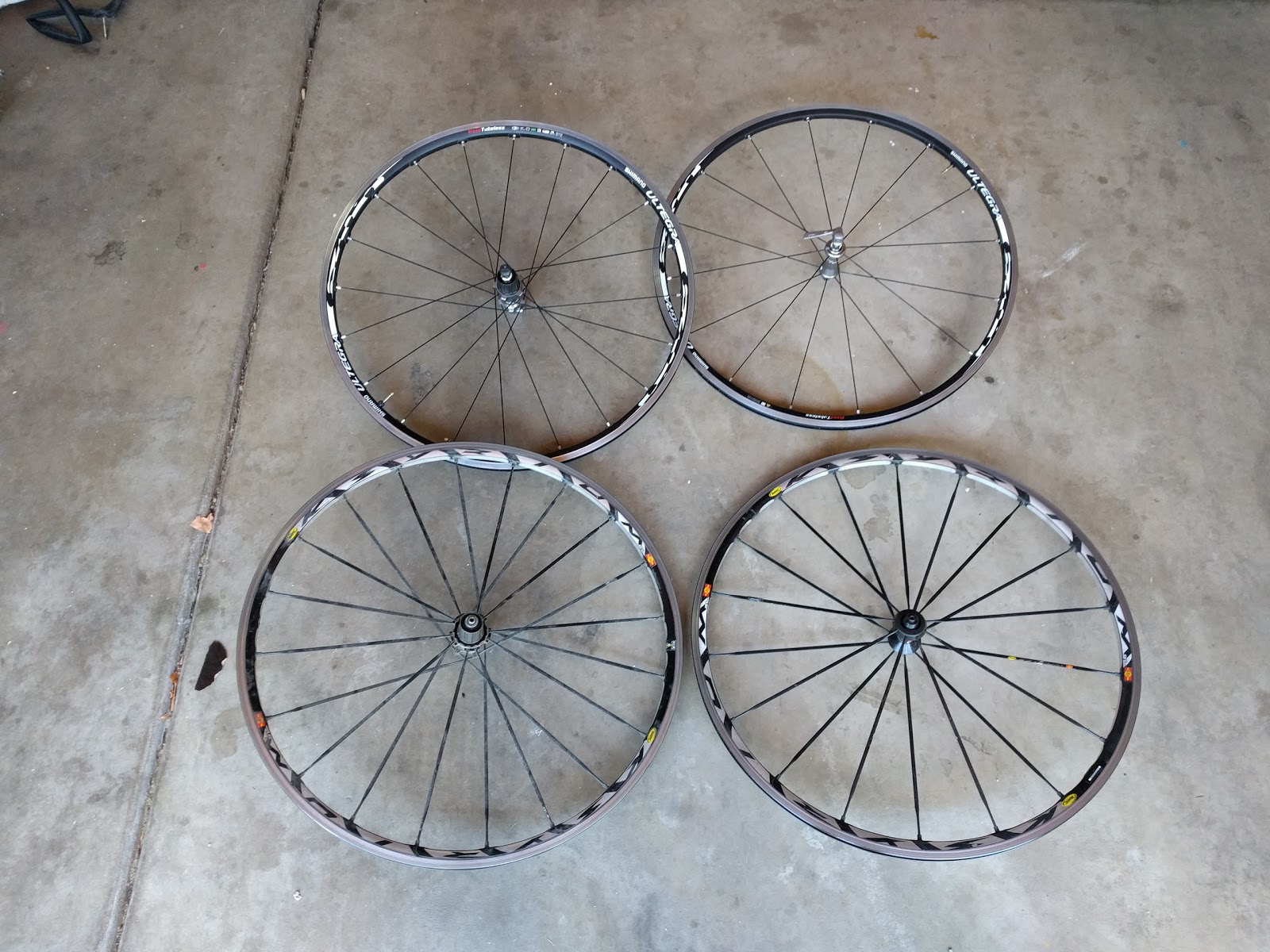
   I came across this great lightly used set of Ultegra wheels on CraigsList, and decided to update my bike. These area pretty standard training wheel, "good for anything up to a race." which is accurate for what I'll use them for.

Old (top) and new (bottom)

   One thing I didn't want to do was take on a huge weight penalty. Here is how the weight difference shakes out. Weights were taken without tires, skewers or cassette:

Mavic front: 1 lb 8 oz
Shimano front: 1 lb 8 oz

Mavic rear: 1 lb 14 oz
Shimano rear: 2 lb 2 oz

   So there's a +4 oz difference - totally acceptable for a new wheel set. If anything needs to be addressed on my bike it is the crank - a heavy replacement for the failed FSA SLK last fall. 
   As the wheel set is newer, the free hub body is set up for an 11 speed so I had to get a spacer from Sports Garage to fit my current 10 speed group:

10 speed spacer

   This was a simple addition and with a little adjustment it was shifting smooth. Here's a show with the new wheels:

All set up!

   While at it, I decided to put on some new rubber as well. The Continentals I was running were getting pretty beat up.

Tire damage 

   I got some Michelin Dynamic Sport tires I was excited to try out. They are 28c tires, larger than the 25c continentals. On the first ride I found out that there really wasn't sufficient clearance with the monster 28c tires, so I reverted to some 25c's. Big tires are going to have to go on the cross bike someday.
   Some of the reviews I read on the Ultrgra wheels said mounting was challenging because they are tubeless, but I was able to get these on with no tools. Maybe those reviewers need to work on their arm strength.